

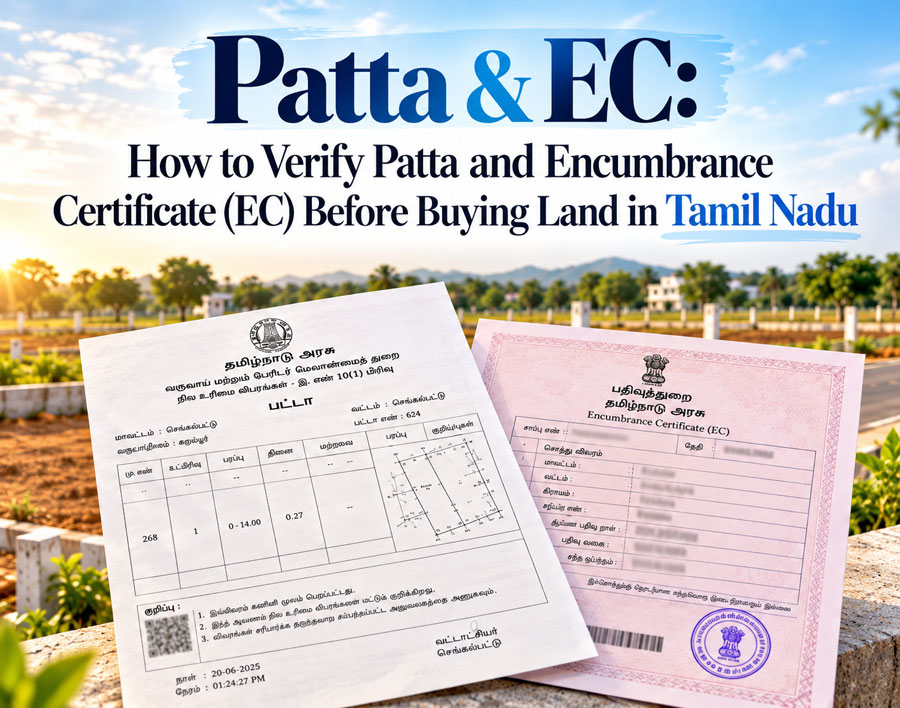
Buying land is a major financial decision, and checking property documents is one of the most important steps before making a purchase. In Tamil Nadu, two documents buyers commonly review are Patta and the Encumbrance Certificate (EC).
Patta provides important land revenue and ownership-record information, while an EC helps identify registered transactions and encumbrances recorded against a property during a specified period. Reviewing both documents, along with the title deed and other relevant records, can help buyers identify potential issues before proceeding.
If you are planning to purchase land, this guide explains how to verify Patta and EC in Tamil Nadu and what to check before finalising your investment.
1. What Is Patta and Why Is It Important?
Patta is a land revenue record maintained by the Tamil Nadu government. It contains details such as the recorded landholder's name, survey number, subdivision details, and land extent, depending on the record.
Before purchasing a plot, buyers should check whether the Patta details match the property documents provided by the seller.
Important details to verify include:
Name of the recorded landholder
Survey number and subdivision number
Village, taluk, and district
Recorded land extent
Land classification and related revenue records
Remember that Patta is an important record, but it does not independently establish conclusive legal title to the property. The ownership chain and supporting documents must also be examined.
2. How to Verify Patta Online in Tamil Nadu
The Tamil Nadu government's land-records portal allows users to view relevant land records online.
Follow these steps:
Visit the official Tamil Nadu Land Records e-Services portal.
Select the relevant land-record service, such as Patta/Chitta or the applicable urban land-record service.
Choose the district and the appropriate rural or urban category.
Enter the required details, such as taluk, village, survey number, and subdivision number, as applicable.
Retrieve the available record and review the displayed information.
Compare the details with the seller's documents and the physical property.
The portal also provides access to records such as A-Register extracts and Field Measurement Book (FMB) information, where applicable. These can help buyers cross-check land classification, measurements, and boundaries.
If the information does not match the seller's documents, seek clarification from the appropriate revenue office before proceeding.
3. What Is an Encumbrance Certificate (EC)?
An Encumbrance Certificate is a document issued through the registration system that records relevant registered transactions affecting a property during a specified period.
Depending on the property's history and the records available, an EC may show transactions such as registered sales, mortgages, releases, or other registered instruments.
An EC is useful for identifying recorded transactions, but it should not be treated as a complete guarantee that a property is free from every legal claim or dispute.
Before buying land, review the EC to understand the recorded transaction history and compare it with the seller's title documents.
4. How to Verify an EC Online in Tamil Nadu
The Tamil Nadu Registration Department provides online EC-related services through its official registration portal.
To review an EC:
Visit the TNREGINET official portal.
Open the Encumbrance Certificate service and choose the relevant search option.
Enter the required property details, which may include the registration zone, district, Sub-Registrar Office, village, survey number, and subdivision number.
Specify the search period based on the property's transaction history.
Complete the required verification and submit the search.
Review the available EC details and obtain the relevant certificate or record through the official service.
The exact fields and available options may vary depending on the search method and property details.
If you are unfamiliar with the process, a qualified property lawyer or authorised document professional can help you obtain and interpret the relevant records.
5. What Should You Check in an EC?
Obtaining an EC is only the first step. You must also review the information it contains.
Pay attention to these details:
Seller details: Check whether the recorded parties correspond with the documents supplied by the seller.
Property description: Verify the survey number, subdivision, extent, and other identifying details.
Registered sale transactions: Compare the recorded transaction history with the title deeds.
Mortgage entries: Check for recorded mortgages or other relevant encumbrances and confirm whether they have been properly discharged.
Search period: Ensure the EC covers an appropriate period for reviewing the property's ownership and transaction history.
A recent EC covering only a short period may not reveal the property's earlier history. Ask a property lawyer to determine the appropriate search period based on the title documents and transaction history.
Also remember that certain claims, disputes, or interests may not appear in an EC. Additional legal and factual verification is therefore essential.
6. Cross-Check Patta, EC, and Title Documents
One of the most important steps before buying land is to compare the information across all relevant documents.
Document | What to verify |
|---|---|
Patta | Recorded landholder, survey details, and extent |
Encumbrance Certificate | Registered transactions and recorded encumbrances |
Parent documents | Previous ownership transfers and title history |
Current title deed | Seller's claimed ownership and property description |
A-Register and FMB records, where applicable | Land classification, measurements, and survey boundaries |
Planning approval, where required | Whether the layout or plot has the relevant approval |
The information should be consistent wherever the records refer to the same property details.
If there are discrepancies in names, measurements, subdivision numbers, or boundaries, do not ignore them. Seek clarification from the relevant authority and obtain independent legal advice before paying an advance or signing an agreement.
7. Common Mistakes to Avoid Before Buying Land
Even when the seller provides Patta and EC documents, buyers should take care not to rely on them without further verification.
Avoid these common mistakes:
Accepting photocopies without checking the underlying records.
Assuming that Patta alone proves complete legal ownership.
Treating a clear EC as a guarantee that no disputes or claims exist.
Ignoring differences in survey numbers or land extent.
Failing to check the property's access, boundaries, and physical condition.
Overlooking applicable layout approvals and land-use restrictions.
Paying a substantial advance before completing legal due diligence.
Taking the time to verify the documents and inspect the property can help reduce avoidable risks.
8. Get Professional Legal Verification Before Finalising the Purchase
Online government records are useful for preliminary checks, but property transactions can involve complex ownership histories, inheritance issues, mortgages, boundary disputes, and other legal matters.
Before finalising your purchase, ask a qualified property lawyer to examine the title chain, relevant registration records, Patta, EC, and other supporting documents. Where necessary, obtain confirmation from the appropriate revenue or registration authorities.
Professional verification is particularly important when records are inconsistent, the property has changed hands several times, or the land forms part of a larger layout.
A careful document verification process can help you make a more informed land purchase and reduce the risk of avoidable property disputes.