

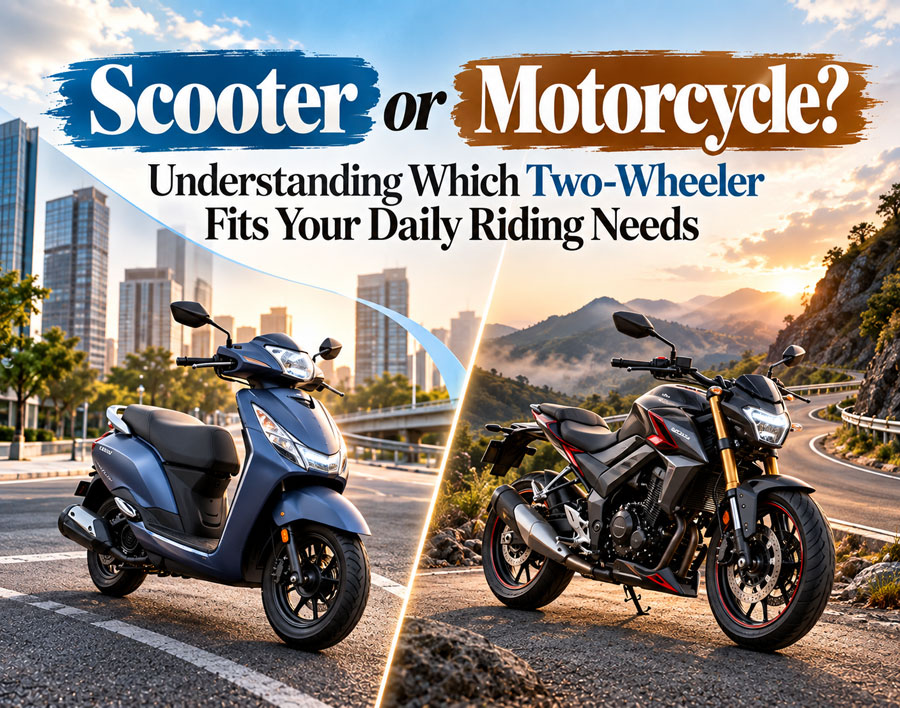
Choosing between a scooter and a motorcycle can be challenging, especially when both offer practical ways to travel every day. Whether you commute to work, travel to college, run errands, or enjoy weekend rides, the right two-wheeler should match your lifestyle and riding preferences.
Scooters are often preferred for their convenience and ease of use, while motorcycles appeal to riders who value different riding styles, performance options, and a traditional geared riding experience. However, the best choice depends on your individual requirements rather than general assumptions.
In this guide, we compare scooters and motorcycles across important factors to help you make an informed decision.
1. Ease of Riding and Handling
One of the biggest differences between scooters and motorcycles is how they are operated.
Scooters typically feature automatic transmission, allowing riders to accelerate and brake without manually changing gears. Their step-through design can also make getting on and off easier.
Motorcycles generally require clutch and gear operation, depending on the model. Riders who enjoy having more control over gear selection may prefer this setup.
For everyday city travel, consider:
Scooter: Convenient for frequent stops, traffic, and short trips.
Motorcycle: Suitable for riders who are comfortable with gears and prefer a traditional riding experience.
Both vehicle types require practice, balance, and safe riding habits. Take a test ride to determine which feels more natural to you.
2. Comfort for Daily Commuting
Comfort plays an important role if you spend a significant amount of time travelling each day.
Many scooters provide an upright riding position and a flat floorboard, which can make them convenient for everyday errands. Motorcycles offer a wide range of seating positions, from upright commuter designs to sportier postures.
When comparing models, check the seat cushioning, handlebar reach, foot placement, suspension, and passenger seating.
If you regularly travel through congested city roads, a lightweight, manageable vehicle may be helpful. For longer commutes, prioritise seat comfort, stability, and riding posture.
The most comfortable option will depend on your height, body proportions, road conditions, and typical journey length.
3. Mileage and Running Costs
Fuel efficiency is an important consideration for regular commuters. However, mileage varies considerably by model, engine capacity, riding style, traffic, maintenance, and road conditions.
Some scooters offer competitive fuel efficiency for urban travel, while many commuter motorcycles are designed to provide economical everyday transportation.
Instead of assuming one category is always more fuel-efficient, compare the real-world mileage of the specific models you are considering.
Also calculate the expected monthly running cost based on your approximate daily distance.
For electric scooters, compare real-world range, electricity costs, charging arrangements, and battery warranty rather than petrol mileage.
4. Storage and Everyday Convenience
Storage is one area where scooters often have a practical advantage.
Many scooters include under-seat storage for small personal items, along with a convenient footboard. Depending on the model, this can be useful for carrying a bag, rainwear, or everyday essentials.
Motorcycles typically provide less built-in storage, although luggage accessories and top boxes can be added to suitable models.
Consider your daily routine:
Scooter: Useful for errands, shopping trips, and carrying small items.
Motorcycle: May suit riders who prioritise riding preferences and are comfortable using a backpack or additional luggage accessories.
Always follow the manufacturer's load limits and avoid carrying items that interfere with steering, balance, or visibility.
5. Performance and Longer-Distance Riding
Your usual travel distance and road type can influence which vehicle suits you better.
Scooters are often convenient for short urban journeys and stop-and-go traffic. Some higher-capacity scooters are also designed for more demanding riding conditions.
Motorcycles are available in a broad range of engine capacities and designs, including commuter, touring, and performance-oriented models. Certain motorcycles may offer advantages in sustained higher-speed riding, depending on their specifications and design.
Before deciding, consider whether you mainly travel within the city, occasionally use highways, or frequently take longer journeys.
Choose a vehicle with appropriate power, braking performance, stability, and comfort for your intended use. Always observe speed limits and local traffic rules.
6. Maintenance and Service Requirements
Maintenance costs depend on the particular vehicle, its design, service schedule, parts, and how it is used.
Both scooters and motorcycles require routine checks and servicing, including attention to tyres, brakes, fluids where applicable, lights, and other components.
Before purchasing, compare:
Scheduled service intervals
Typical servicing costs
Spare-parts availability
Warranty coverage
Local authorised service facilities
Replacement costs for wear-and-tear components
If you are considering an electric scooter, check battery warranty conditions, replacement costs, and access to qualified service support.
A model with convenient service access and transparent maintenance requirements can make daily ownership easier.
7. Price, Safety, and Overall Value
Your final decision should consider the total cost of ownership, not just the initial price.
Compare the on-road price, insurance, registration, fuel or electricity expenses, maintenance, and any loan payments. A model that costs less upfront may not necessarily be the most economical over several years.
Safety should also be a priority. Compare braking systems, tyre quality, lighting, handling, and the safety equipment offered in the exact variant.
Check whether features such as ABS or CBS are available and understand how the braking system works. Always wear a properly fitted, certified helmet and use appropriate protective gear.
Choose a vehicle that offers the right balance of affordability, comfort, safety, and practicality for your everyday needs.
Scooter vs Motorcycle: Quick Comparison
Feature | Scooter | Motorcycle |
|---|---|---|
Transmission | Usually automatic | Usually geared; automatic models also exist |
City commuting | Convenient for frequent stops | Suitable for many types of city travel |
Storage | Often includes under-seat storage | Usually needs additional luggage solutions |
Riding style | Often simple and convenient | Offers a wider variety of riding styles |
Fuel efficiency | Depends on the model | Depends on the model |
Longer rides | Depends on design and capacity | Many models are designed for touring and longer journeys |
Maintenance | Varies by model | Varies by model |
How to Make the Right Choice
Before buying, ask yourself a few simple questions:
Do I mainly travel short distances in city traffic?
Do I need convenient storage for everyday items?
Am I comfortable operating a geared motorcycle?
How much can I spend on the vehicle and monthly running costs?
Will I regularly travel with a passenger or take longer journeys?
Are service centres and spare parts easily accessible near me?
Shortlist two or three suitable models,