

Choosing the right construction materials is essential for building a strong, durable, and reliable structure. Among these materials, Manufactured Sand (M Sand) plays an important role in concrete, masonry, and plastering applications.
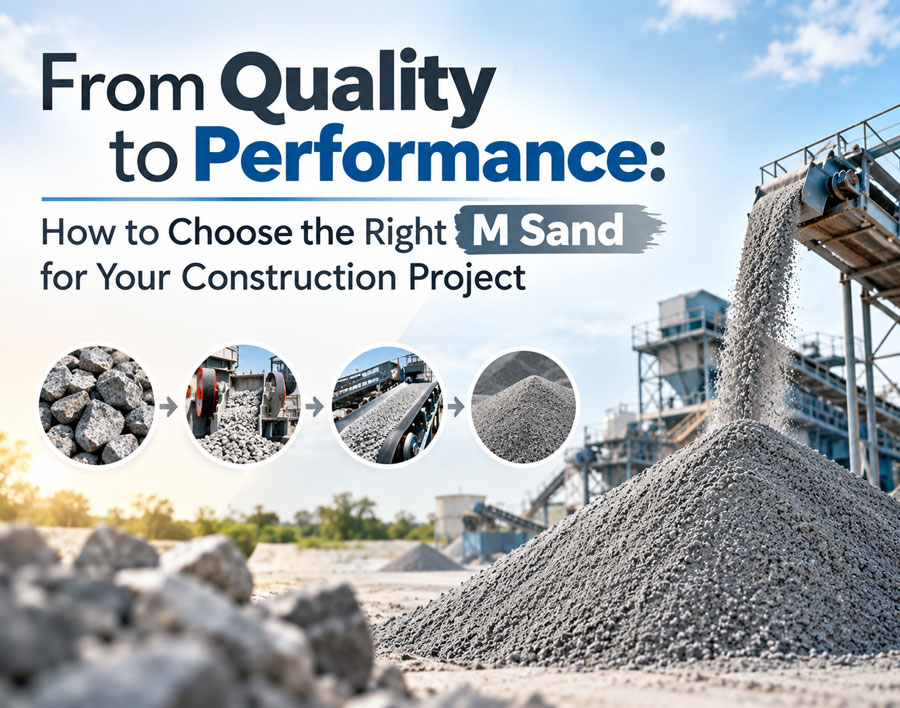
M Sand is produced by crushing suitable rocks into sand-sized particles and processing them to achieve the required grading. However, not every M Sand product is suitable for every construction activity. Its quality, particle size, cleanliness, and compliance with relevant specifications can influence workability and the performance of the finished structure.
If you are planning a house or commercial building, understanding how to choose the right M Sand can help you select a suitable product for your project's needs.
1. Understand the Different Types of M Sand
Before purchasing M Sand, identify the type required for your construction activity. Different applications may need different particle sizes and grading characteristics.
Common categories include:
Concrete M Sand: Intended for use as fine aggregate in concrete when it meets the applicable specifications.
Plastering M Sand: Processed for suitable grading and finishing characteristics required for plastering.
Masonry M Sand: Used in mortar for brickwork or blockwork when the product meets the relevant requirements.
These categories are not interchangeable in every situation. Ask your supplier for the product's intended use and confirm the required grade with your engineer.
2. Check Particle Size and Grading
Particle size and grading are important factors when selecting M Sand. Grading describes the distribution of different particle sizes within the material.
Appropriate grading can support workability, packing, and the performance of concrete or mortar. Material that is excessively coarse, excessively fine, or poorly graded may not suit the intended mix.
Before purchasing, check:
Whether the product meets the grading requirements for its application.
Whether the supplier can provide relevant sieve-analysis results.
Whether the material is consistent between deliveries.
Whether the grading matches the approved mix design or project specifications.
Do not assume that one particle-size range is suitable for every construction activity.
3. Evaluate Cleanliness and Impurities
The cleanliness of M Sand can affect the performance of construction mixes. Excessive clay, silt, unwanted dust, organic matter, or other harmful impurities may affect the material's suitability.
Although M Sand is manufactured, its quality still depends on the source rock and the processing and washing methods used.
When evaluating a product, consider:
The presence of clay lumps or visible contamination.
The quantity and characteristics of fine particles.
Relevant laboratory test results.
The supplier's material-processing and quality-control practices.
Visual inspection can identify some obvious problems, but laboratory testing is needed to establish whether the material meets the required specifications.
4. Choose M Sand Based on the Construction Application
The right M Sand depends on where and how it will be used.
For Concrete Work
Concrete M Sand should meet the applicable fine-aggregate requirements and be suitable for the specified concrete mix.
Its grading, particle characteristics, cleanliness, and other relevant properties should be evaluated according to the project specifications.
The concrete mix should be designed or approved by the responsible engineer or concrete supplier rather than adjusted informally at the construction site.
For Plastering
Plastering requires material with suitable grading and finishing characteristics. M Sand intended for concrete should not automatically be used for plastering without checking its suitability.
Ask for plastering-grade M Sand that meets the requirements of the specified plaster mix.
For Masonry Work
Masonry mortar needs suitable workability and performance for laying bricks or blocks. Select M Sand that meets the requirements for the intended mortar and follow the specified mix proportions.
Choosing the correct product for each application can help improve consistency and reduce avoidable workmanship issues.
5. Verify Quality Standards and Test Reports
A supplier's quality claims should be supported by relevant documentation wherever applicable.
Before placing a large order, ask for test reports or other quality records that demonstrate compliance with the specifications required for your project.
Depending on the application, relevant checks may include grading, fines content, deleterious materials, and other aggregate properties.
In India, the applicable BIS standards and project specifications should guide material acceptance. Confirm the relevant standard with your engineer, as requirements may differ by intended use.
A reliable supplier should be able to explain the product grade, its intended application, and the available quality documentation.
6. Compare Price Without Compromising Quality
Price is an important consideration, particularly for projects involving large quantities of construction materials. However, choosing M Sand based only on the lowest quotation can create problems if the product is inconsistent or unsuitable.
When comparing suppliers, consider:
Price per tonne or cubic metre.
Transportation and unloading costs.
Material grade and intended application.
Availability of test reports.
Consistency between deliveries.
Delivery schedules and supply reliability.
Compare the total delivered cost and material quality rather than looking at the quoted price alone.
A product that meets the required specifications can help reduce the risk of wastage, rework, and delays.
7. Inspect the Material Before Accepting Delivery
Quality checks should continue after you select a supplier. A delivered batch should match the agreed product grade and project requirements.
Before accepting a delivery:
Confirm the product type and quantity.
Check for obvious contamination or foreign materials.
Compare the delivered material with the approved sample or specifications, where applicable.
Review the required documentation.
Arrange additional testing if the material appears inconsistent or the project requires it.
Store the material in a clean, suitable area and take precautions to prevent contamination from soil, debris, or other construction materials.
For major projects, establish a consistent inspection and testing process with the responsible engineer.
8. Select a Reliable M Sand Supplier
The supplier is an important part of maintaining material quality throughout a construction project.
Look for suppliers who can clearly explain their production process, material grade, source, delivery arrangements, and quality-control procedures.
Before making a decision, ask:
Is the material suitable for my specific construction activity?
Can you provide relevant test reports?
Is the quality consistent across deliveries?
Can you supply the required quantity on schedule?
Are transportation and unloading included in the quotation?
Can the material's source and supply details be verified?
Working with a reliable supplier can make procurement more predictable and help reduce disruptions during construction.
9. Understand How M Sand Affects Construction Performance
M Sand is one component of a larger construction system. Its performance depends on how well it meets the required specifications and how it is used in the mix.
For concrete, factors such as cement content, water-cement ratio, aggregate grading, admixtures, mixing, placing, compaction, and curing all influence the final result.
For plastering and masonry, the mix proportions, substrate preparation, application methods, and curing practices are also important.
Therefore, good-quality M Sand alone cannot guarantee a strong or durable structure. The material must be used correctly within a properly designed and executed construction process.
10. Follow Professional Guidance Before Finalising Your Choice
Every construction project has its own requirements depending on the structural design, application, environmental conditions, and relevant standards.
Before finalising your M Sand purchase, consult the project engineer or qualified construction professional. Confirm the required product grade, acceptance criteria, mix design, and testing requirements.
Avoid changing the sand type or mix proportions without approval, especially for structural concrete.
Following professional guidance helps ensure that the selected material is appropriate for the intended work and consistent with the project's quality requirements.
Conclusion
Choosing the right M Sand involves more than comparing prices or selecting the first available product. Particle grading, cleanliness, application suitability, quality documentation, supplier reliability, and proper handling all matter.
Whether you are constructing a house or managing a larger building project, select M Sand that meets the relevant specifications for its intended use and have its suitability confirmed by the responsible professional.
The right M Sand, combined with proper mix design and good construction practices, can contribute to consistent workmanship and reliable building performance.