

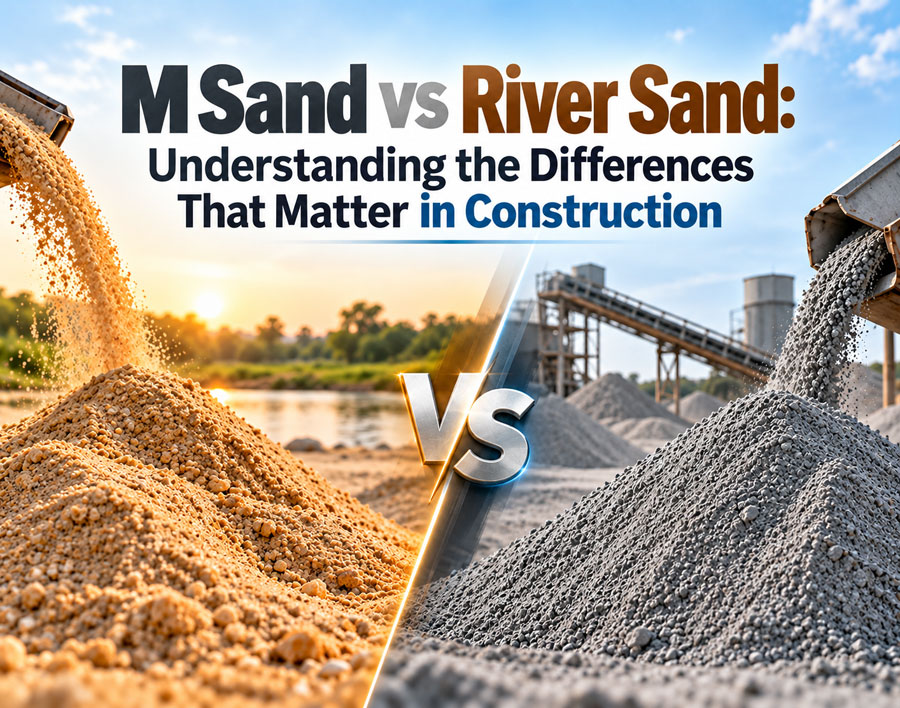
Sand is an essential material in construction, playing an important role in concrete, mortar, plastering, and other building applications. Choosing the right type of sand can influence the workability, strength, finish, and durability of a construction project.
Two commonly discussed options are Manufactured Sand (M Sand) and river sand. While both are used in construction, they differ in how they are produced, their particle characteristics, availability, and suitability for specific applications.
If you are planning to build a house or manage a construction project, understanding M Sand vs River Sand can help you make a more informed material selection.
1. What Is M Sand?
Manufactured Sand, commonly known as M Sand, is produced by crushing suitable hard rock into sand-sized particles using specialised machinery. The material is processed and graded to meet the requirements of its intended application.
Unlike naturally deposited river sand, M Sand is manufactured under controlled processing conditions. Its quality depends on the source rock, crushing process, grading, washing, and quality-control practices used by the producer.
M Sand is widely considered for concrete and masonry applications where the product meets the relevant specifications.
2. What Is River Sand?
River sand is naturally occurring sand collected from river deposits or other permitted natural sources. It is formed over time as rocks and minerals break down through natural weathering and erosion.
Its particle shape, size distribution, and mineral composition vary according to the source and processing methods.
River sand has traditionally been used in construction for concrete, mortar, and plastering. However, its suitability depends on its cleanliness, grading, and compliance with the relevant application requirements.
Buyers should ensure that sand is sourced legally and supplied with appropriate quality documentation.
3. Key Differences Between M Sand and River Sand
The following table highlights some general differences. Actual properties vary by source and product quality.
Feature | M Sand | River Sand |
|---|---|---|
Source | Manufactured by crushing suitable rock | Naturally occurring river deposits |
Particle shape | Often more angular | Often more rounded, depending on the source |
Grading | Can be controlled through processing and screening | Varies with natural deposits and processing |
Availability | Can be produced near suitable rock sources | Depends on permitted natural sources and supply |
Quality consistency | Can be consistent with effective quality control | May vary between sources and batches |
Environmental considerations | Quarrying, crushing, and transport have environmental impacts | Extraction can affect river systems and sediment balance |
Cost | Depends on processing, transport, and local supply | Depends on permitted availability, transport, and local supply |
Construction suitability | Depends on grading and specifications for the application | Depends on grading, cleanliness, and specifications for the application |
Neither material should be selected based on appearance or price alone. The intended use and verified quality are important.
4. Which Sand Is Better for Concrete?
Concrete requires suitable fine aggregate to achieve the required workability, strength, and durability.
M Sand can be suitable for concrete when it meets the applicable grading, cleanliness, and material-quality requirements. Its manufactured grading can offer consistency when production and testing are properly controlled.
River sand can also be suitable when its properties meet the required specifications.
Before selecting sand